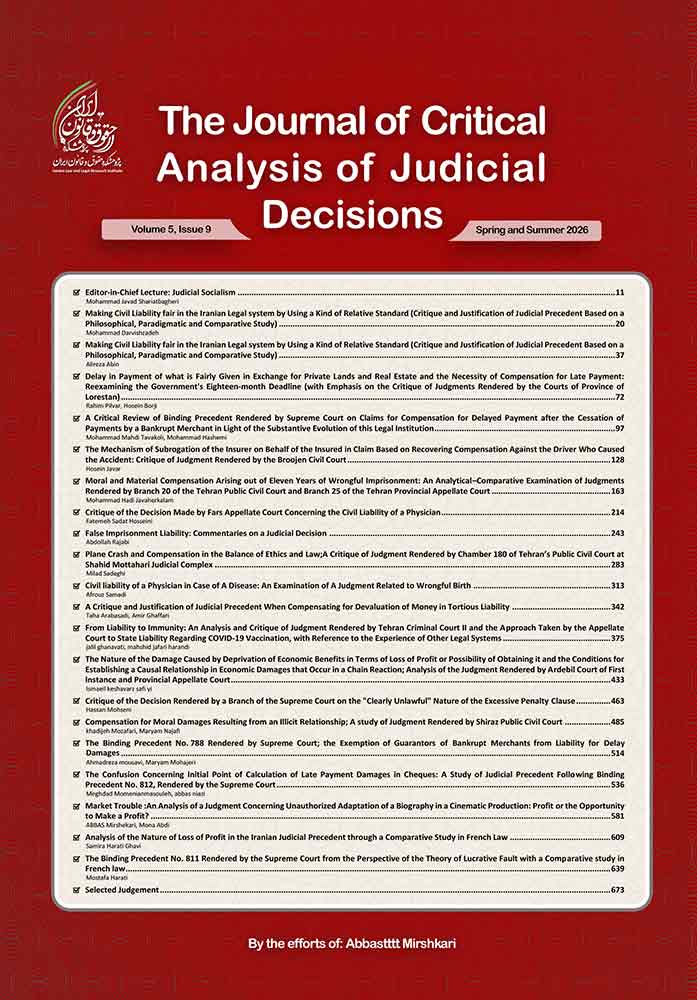
The Journal of Critical Analysis of Judicial Decisions

The Journal of Critical Analysis of Judicial Decisions

A Critique of the Exemption of Guarantors of Bankrupt Merchants from Liability for Delay Damages: With Emphasis on Supreme Court Unifying Decision No. 788

Document Type : Original Article

Authors
1 Department of private law, Faculty law, University of Emam sadegh, Tehran, Iran
2 Assistant Professor of Law,Faculty of Social Science, University of Teheran, Tehran, Iran
Abstract
In its Unifying Decision No. 155 dated 14/12/1347, the Supreme Court of Iran held that a bankrupt merchant is not liable for damages arising from delay in the payment of his commercial debts. In subsequent years, divergent judicial opinions emerged regarding the extension of this ruling to the guarantors of a bankrupt merchant. The Supreme Court once again resolved this divergence by issuing Unifying Decision No. 788 dated 27/3/1399, holding that guarantors, like the merchant himself, are exempt from compensating damages for delay in payment. Taken together, these two unifying decisions have created grounds for extensive abuse by certain merchants and have been subject to criticism by capital providers, particularly banks and financial and credit institutions. The present study seeks to answer the question of what constitutes the legal basis for exempting the guarantor from the payment of delay damages, and what criticisms this exemption faces. The findings of this research—conducted through a descriptive–analytical method and based on library resources—indicate that the foundation of such exemption lies in the accessory (dependent) nature of the contract of guarantee (ʿaqd al-ḍamān). Pursuant to certain provisions of the Commercial Code and the Civil Code, and in conformity with Islamic jurisprudence, guarantee is deemed an accessory contract; accordingly, when the principal obligor (maḍmūn ʿanhu, i.e., the merchant) is discharged from payment of the debt, the liability of the guarantor is likewise extinguished. For this reason, the Supreme Court, in the aforementioned decision, ruled in favor of the guarantor’s exemption. Nevertheless, the discharge of the guarantor’s obligation is subject to several criticisms. The most significant criticism concerns the incompatibility of such exemption with the purpose and underlying philosophy of the contract of guarantee. The objective of guarantee is that, should the principal debtor intentionally or due to inability fail to discharge his obligations, the creditor (maḍmūn lahu) may readily recover the debt by recourse to the guarantor. However, if the exemption of the principal debtor from liability for delay damages results in the exemption of the guarantor as well, the fundamental purpose and intent of the guarantee contract are undermined.
Keywords

Abdipour Fard, E. (2024). Pathology and model proposal for bankruptcy in the Iranian legal system (2nd ed.). Tehran: Center for Press and Publications of the Judiciary. (In Persian)
Anvari Pour, S. M. (1974). Bankruptcy in Iranian law. Tehran: Babak. (In Persian)
Erfani, M. (2002). Commercial law. Tehran: Mizan. (In Persian)
Ghaem Magham Farahani, M. H. (1989). Commercial law: Bankruptcy and liquidation. Tehran: University of Tehran Press. (In Persian)
Katoozian, N. (2017). Introductory course in civil law: Lessons from specified contracts (27th ed.). Tehran: Ganj Danesh. (In Persian)
Mo’in, M. (2018). Farhang-e Farsi-e Mo’in. Tehran, Iran: Amir Kabir Publishing Institute. (In Persian)
Ramazan Zadeh Badali, E., & Hosseini Moghadam, S. H. (2022). A critique of Supreme Court precedent No. 788 in light of the violation of the independence of commercial law vis-à-vis civil law. Judiciary Law Journal, 86(118), 97–114. doi: 10.22106/jlj.2021.539086.4412 (In Persian)
Samatvati, H. (2016). Principles of bankruptcy: An analytical and theoretical study of bankruptcy of individual traders and commercial companies in Iranian law. Tehran: Majd. (In Persian)
Soleimani, A., Iranshahi, A., & Azizi, M. (2018). Liability of guarantors of bankrupt traders for delayed payment damages after bankruptcy. Research of Nations, 4(39), 79–102. http://noo.rs/I47Wj (In Persian)
Soleymanzadeh, S. (2023). Legal intervention in the acts of a bankrupt merchant: A critique of the Supreme Court unification ruling No. 561. Biannual Journal of Critique and Analysis of Judicial Decisions, 2(4), 207–225. doi: 10.22034/analysis.2023.2008448.1054 (In Persian)
Tavakkoli, M. M., & Hashemi, M. (2025). Legal analysis of the time of currency conversion of foreign debt in bankruptcy: A review of the Supreme Court unification ruling No. 861. Biannual Journal of Critique and Analysis of Judicial Decisions, 4(7), 57–90. 10.22034/analysis.2025.728584 (In Persian)