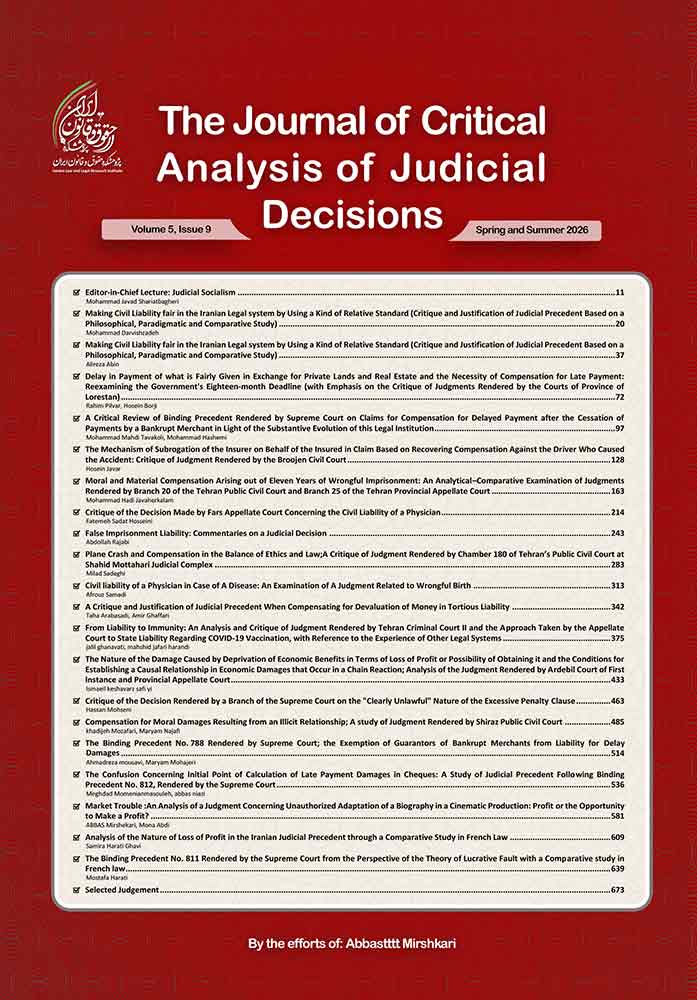
The Journal of Critical Analysis of Judicial Decisions

The Journal of Critical Analysis of Judicial Decisions

False Imprisonment Liability: Commentaries on a Judicial Decision

Document Type : A critique of the civil court's judgment

Author
Assistant Professor, University of Tehran, (Farabi Campus), Tehran, Iran.
Abstract
A case unfolds involving an individual who was originally condemned to death for drug trafficking offenses. His conviction was subsequently subject to several judicial reviews, resulting in a commutation to life imprisonment, a further reduction to a twenty-five-year sentence, and eventually an acquittal after it was determined that the initial conviction conflicted with Sharia law, following the defendant’s eleven years of imprisonment. After being released, the claimant initiated civil action against the Ministry of Justice, seeking compensation for unlawful detention. Both the lower court and the appellate court ruled in favor of the claimant, affirming the entire claim. This article offers a critical legal analysis of the adjudicated claims and explores possible underlying reasons, as well as potential causes of action that were not advanced by the claimant, within the framework of Iranian law. The relevant judgments merit close scrutiny, as they reveal enduring tensions in judicial reasoning and raise intricate questions of both procedural and substantive law.From a procedural standpoint, the study assesses the jurisdictional authority of civil courts and the necessary preliminary requirements for initiating state liability claims.On the substantive level, it evaluates the contours of state responsibility, with particular emphasis on the possible tortious liability of judges whose decisions contributed to the initial wrongful conviction.In addition, the analysis considers the classification of compensable harm, particularly the distinction between pecuniary and non-pecuniary losses, as well as the suitability of claims for lucrum cessans (loss of profits) under the current legal system. It further examines the methods applied in the assessment and quantification of damages.Beyond the explicitly asserted claims, the study identifies additional categories of harm, including the deprivation of opportunities and the physical and psychological risks of imprisonment, and argues that members of the claimant’s family may, in principle, claims for their independent damages.In conclusion, the article emphasizes that the legitimacy of the judicial process depends upon strict observance of procedural and substantive legal norms. It contends that, in cases involving state-imposed harm, the judiciary must prioritize legal certainty and due process as foundational pillars for preserving the integrity of civil justice. This recommended judicial methodology is to seek an equitable resolution at the outset—abstracting from the strictures of statutory rules—before grounding the final decision in legal provisions so as to preserve procedural integrity and uphold the ideal of equal treatment before the law.This approach is reflected, to a commendable degree, in the reviewed decisions of competent authorities; however, further refinement remains both possible and desirable.


Keywords

Babaei, Iraj (2015) Tort law. 1st ed.,. Tehran: Mizan [In Persian].
Barikloo, Alireza (2014). Civil Responsibility, 5th Ed, Tehran, Mizan Legal Foundation. [in Persian]
Bahrami Ahmadi, Hamid (2018), Non-Contractual Liability (Civil Liability) with a Comparative Study in Islamic Jurisprudence and Legal Systems, 2nd ed., Tehran: Imam Sadegh University Press. [in Persian]
Darvishzadeh,M. (2023). Rationalism and Irrationality in Judicial Decision. The Journal of Critical Analysis of Judicial Decisions, 2(3), doi: 10.22034/analysis.2023.707618.
Katouzian, N. (2011). Civil Liability, Extra-contractual obligations. Vol. 1, Tehran University. [in Persian]
Mirshkari,A. and Hosseini,F. (2023). A Comparative Study of The way of compensation for moral damages: with emphasizing the judicial procedure of Iran. The Judiciarys Law Journal, 87(121), 351-378. doi: 10.22106/jlj.2022.544179.4557.
Rajabi, A. (2020). Requirements of Anticipatory Actions in Tort Law. Law Quarterly, 50(4), 687-706. doi: 10.22059/jlq.2020.273694.1007161, [in Persian].
Rahpeik, Hassan (2016), Civil liability & Law of Remedies, 1st ed., Tehran, Khorsandi [in Persian].
Rajabi,A. and Pirhaditavandashti,M. (2024). Moral Damages in Private International Law. Islamic Law, 21(82), 101-130. doi: 10.22034/ilaw.2023.708738.
Safai. S. H., & Rahimi. H (2014). Civil liability (non-contractual obligation). 6th Ed., Tehran: Samt. [in Persian]
Safaii, H., & Razi, S. (2020). Civil Liability of the Judge and Its Evolution in the Imamiyah Jurisprudence and Law of Iran and France. Comparative Studies on Islamic and Western Law, 7(3), 121-148. doi: 10.22091/csiw.2020.4542.1605.
Saket,M. H. (2025). An Introduction to Reframing Judicial Decision Through the Lens of Legal History and Philosophy. The Journal of Critical Analysis of Judicial Decisions, 4(7), 183-207. doi: 10.22034/analysis.2025.728149.
Shariatbagheri,M. J. (2023). The personalization and tastefulness of Iranian law. (e707617). The Journal of Critical Analysis of Judicial Decisions, 2(3), doi: 10.22034/analysis.2023.707617.
SHAYEGAN, E. and ASHOURI, M. (2018). The legal system of compensation for damage caused by the arrest of the accused innocent; Research in comparative law and Iranian law. Journal of Criminal Law Research, 6(23), 47-79. doi: 10.22054/jclr.2018.16647.1309.
Send comment about this article
Enter Name.
Enter a valid email address.
Enter a vaid affiliation.
Enter comments (At leaset 10 words)
CAPTCHA Image
Enter Security Code Correctly.