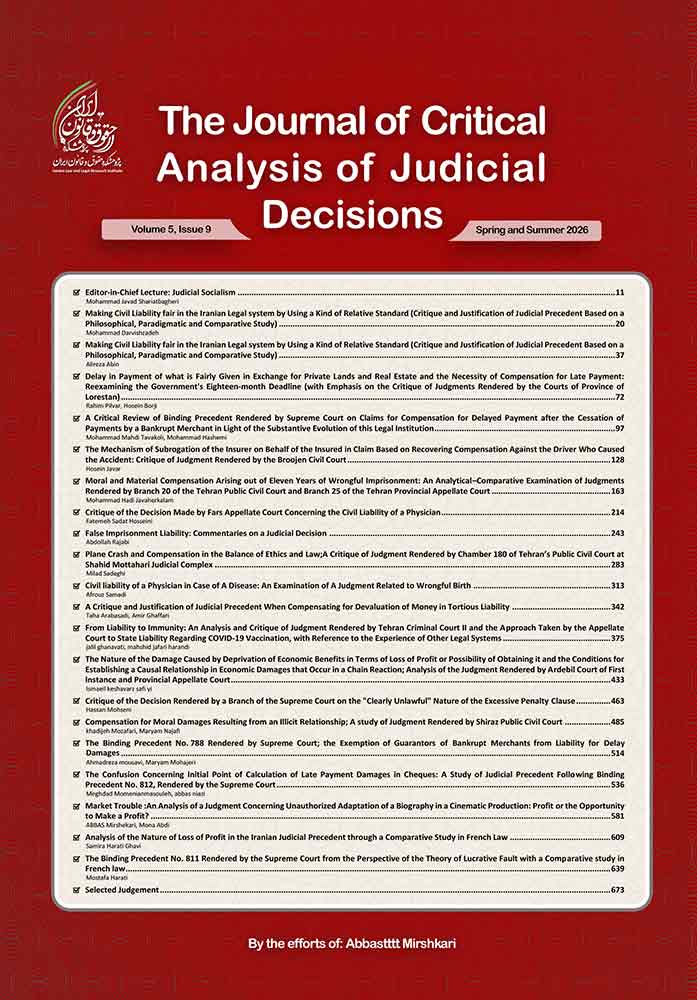
The Journal of Critical Analysis of Judicial Decisions

The Journal of Critical Analysis of Judicial Decisions

Critique of the Decision Rendered by a Branch of the Supreme Court on the "Clearly Unlawful" Nature of the Excessive Penalty Clause

Document Type : A critique of a Cassation Court's decision

Author
Professor of the Department of Private and Islamic Law - Faculty of Law and Political Science - University of Tehran, Tehran, Iran
Abstract
If a final judgment is reversed on the basis of the Sharia, this reliance must be explicitly stated in the reversal of the judgement.The general grounds of conflict with the Sharia standards should not lead to setting aside the final judgment. Sharia is a legal system containing mandatory and supplementary rulings. The phrase "clearly contrary to the sharia", in the author's opinion, means that the judgment in question contradicts the mandatory part of the Sharia, and not any ruling in the Sharia. Dealing with the procedural and merits of claims in the Supreme Court after the head of the judiciary has authorized a de novo proceedings, allows the branch to which it was referred, for example in the present case where the penalty clause is considered excessive, to assess the appropriate amounts of damages by obtaining the opinion of an expert and to make a ruling accordingly.Reversal of a judgment, issuing of a judgment to dismiss a plaintiff's claim, and recommending that he should file a new pleading, simply based on the general principles of the Civil and Civil Liability Acts, is highly questionable.


Keywords

1.        Javaherkalam, M. H. and R. Kazemzadeh, "The argument and Manner of Modification of Liquidated Damages; Resistance of Judicial Precedent Against an Inappropriate Law (By a Comparative Study of French and English Law and International Instruments)," Journal of Research and Development in Comparative Law, 8 26 (2025): 9-49, doi: 10.22034/law.2024.2038510.1446 (in persian)
2.        Katouzian, Naser, (2002), Genaral Rules of Contracts, Tehran, Enteshar, 3rd Ed.
3.        M. ShariatBagheri, "Editor-in-Chief Lecture: In search of reasoned and documented court’s decisions? Or the firmness of judicial decisions?," The Journal of Critical Analysis of Judicial Decisions, 4 8 (2026): 9-17, doi: 10.22034/analysis.2026.733546 (in persian)
4.        Mohseni, Hassan, (2010), Organazing the civil procedure, according to cooperation theory & in framework of principles of procedure,  Tehran, Enteshar.
5.        Naheini, Fereidoon, (2016), Revision by Chief of Judicial Power, Tehran, Guanjedanesh.
Send comment about this article
Enter Name.
Enter a valid email address.
Enter a vaid affiliation.
Enter comments (At leaset 10 words)
CAPTCHA Image
Enter Security Code Correctly.