The Journal of Critical Analysis of Judicial Decisions

The Journal of Critical Analysis of Judicial Decisions

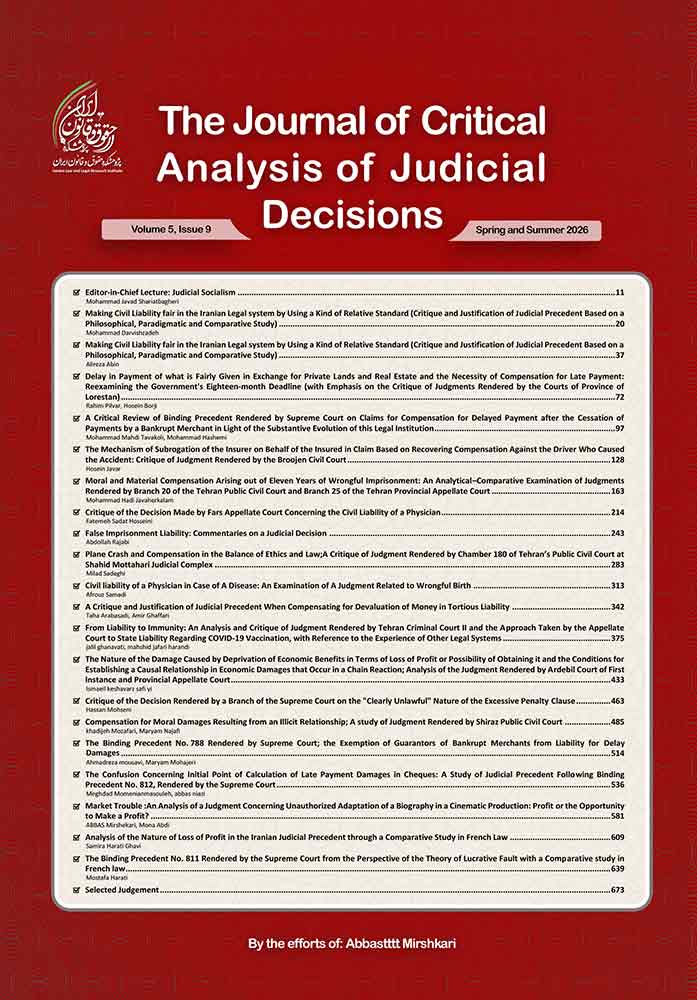
A Critical Review of Binding Precedent Rendered by Supreme Court on Claims for Compensation for Delayed Payment after the Cessation of Payments by a Bankrupt Merchant in Light of the Substantive Evolution of this Legal Institution

Document Type : Original Article

Authors
1 Ph.D. in Private Law, Faculty of Law and Political Science, University of Tehran, Tehran, Iran
2 LLM Student in Private Law, Department of Private Law, Faculty of Islamic Studies and Law, Imam Sadiq University, Tehran, Iran.
Abstract
The binding precedents rendered by the Supreme Court regarding the possibility of claiming compensation for delayed payment after the date the bankrupt businessman has ceased to repay his debt, in light of the substantive evolution of this institution, have faced challenges in terms of reasoning bases and the degree of compliance with current law.The continued reliance on a decision that ruled out the claim for damages for delayed payment after the date of the bankrupt businessman's cessation (binding precedent No. 155), along with the formation of later judgments that have adopted a different approach, has revealed a need for a critical re-reading of this procedure.The present study seeks to answer the question of what impact substantive evolution of late payment damages has had on the validity and ability to continue reliance on binding precedent No. 155 and the judgments based on it, and what changes have recent binding precedents made in this procedure. The findings of the research demonstrated that the binding precedent No. 155, considering the concept of late payment damages under
the pre-revolutionary legal framework, which was close in nature to a legal penalty, was coherent and defensible at the time of its issuance.However, following the enactment of Article 522 of the Civil Procedure Code and the transformation of this institution into a mechanism for compensating for depreciation of currency, maintaining the approach that upholds absolute prohibition of claiming this damage in subsequent decisions (binding precedents Nos. 788 and 872) would not be consistent with current legal foundations.In contrast, recent decisions rendered by the Supreme Court, by accepting the necessity of preserving the real value of claims and the possibility of compensating for the decline in the value of a claim, assuming the existence of excess assets (binding precedent No. 877), indicate a change in the Supreme Court's approach.Accordingly, the present research concludes that by accepting the possibility of compensation for decrease in the value of a claim, assuming the existence of excess assets, binding precedent No. 877 has provided the basis for departing from the logic governing binding precedent No. 155 and the decisions based on it. Therefore, instead of continuing to rely on previous decisions, it is appropriate for judicial practice to align itself with the approach adopted in binding precedent No.877, and the liability of guarantors and managers of bankrupt companies should be reexamined in the light of this development.


Keywords

1.      Anvari, H. (2003). Farhang-e Bozorg-e Sokhan [The Great Sokhan Dictionary] (Vol. 4, 2nd ed.). Tehran: Sokhan Publications. (in Persian)
2.      Osta, M. H., Afras, G., & Ahmadi, J. (2023). A Comparative Analysis of the Recoverability of Loss of Chance Resulting from Delay in Monetary Payment in Islamic Jurisprudence and Law. Comparative Law Research and Development Quarterly, 6(19). Doi: 10.22034/law.2023.2000902.1239 (in Persian)
3.      Bankruptcy Administration Act. (1939). Enacted July 15, 1939. (in Persian)
4.      Cheque Issuance Act. (1976). As amended. (in Persian)
5.      Civil Code of Iran. (1928). As amended. (in Persian)
6.      Civil Procedure Code. (1939). Enacted September 17, 1939. (in Persian)
7.      Civil Procedure Code of the Islamic Republic of Iran. (2000). Enacted April 10, 2000, as amended. (in Persian)
8.      Commercial Code of Iran. (1932). As amended. (in Persian)
9.      Constitution of the Islamic Republic of Iran. (1979). As amended. (in Persian)
10.   Eskini, R. (2023). Commercial Law: Bankruptcy and Liquidation Proceedings (29th ed.). Tehran: SAMT. (in Persian)
11.   Expedited Proceedings Act. (1930). (in Persian)
12.   Moein, M. (2002). Moein Dictionary (Vol. 1, 86th ed.). Tehran: Adna Publications. (in Persian)
13.   Registration of Deeds and Real Estate Act. (1932). (in Persian)
14.   Regulations of the Minister of Justice on Time Limits and Deposits. (1928). (in Persian)
15.   Safaei, S. H. (2022). General Principles of Contracts (37th ed.). Tehran: Mizan Publications. (in Persian)
16.   Shahidi, M. (2022). Discharge of Obligations (17th ed.). Tehran: Majd Publications. (in Persian)
17.   Shahidi, M. (2022). Effects of Contracts and Obligations (10th ed.). Tehran: Majd Publications. (in Persian)
18.   Shiravi, A. (2001). A Critical Review of the Civil Procedure Code Provisions on Contractual Damages and Damages for Delay in Payment. Journal of Qom Higher Education Complex, 3(9). (in Persian)
19.   Sobhani, J. (2023). Al-Mujaz fi Usul al-Fiqh (34th ed.). Qom: Imam Sadiq Institute. (in Arabic)
20.   Temporary Code of Civil Procedure. (1911). (in Persian)
21.   Tavakkoli, M. M. (2023). Comprehensive Commercial Law (Vol. 2, 7th ed.). Tehran: Maktoub Akhar. (in Persian)
22.   Tavakkoli, M. M., & Hashemi, M. (2025). A Legal Analysis of the Time of Currency Conversion of Foreign Currency Debts in Bankruptcy: A Study of Supreme Court Unification Judgment No. 861. Biannual Journal of Critique and Analysis of Judicial Decisions, 4(7). Doi: 10.22034/analysis.2025.728584 (in Persian)
23.   Vahdati Shobeiri, S. H. (2003). Damages for Delay in Payment of Monetary Obligations. Human Sciences Methodology, 9(36). (in Persian)
24.   Act on the Collection of Banks' Claims. (1990). (in Persian)
 
 
Send comment about this article
Enter Name.
Enter a valid email address.
Enter a vaid affiliation.
Enter comments (At leaset 10 words)
CAPTCHA Image
Enter Security Code Correctly.